

Forehand Topspin – The Kinematic Chain
Courtesy of andro Table Tennis Coach Jens Stoetzel
There are tons of instructions how to play a forehand topspin (short form: FHT). All these instructions have many things in common while they differ only in a very few points. But when you take a look at the pro’s topspin strokes you can easily see that every player has found his own style.
Although they have always the same target: generating the best possible acceleration when the racket hits the ball!
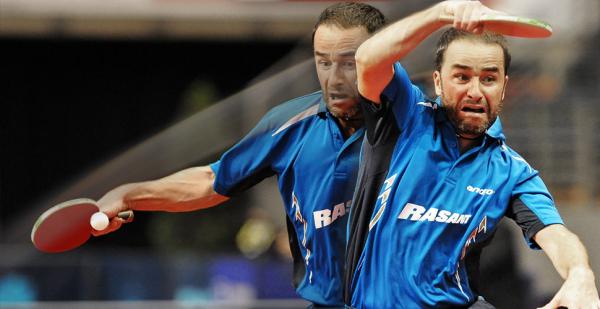 Professional players are the best proof that the way to this target can vary. The physical constitution, rubbers, blades and the technical education have a huge influence on the player’s technique. Though a few key points – based on biomechanical rules – are valid for every player:
Professional players are the best proof that the way to this target can vary. The physical constitution, rubbers, blades and the technical education have a huge influence on the player’s technique. Though a few key points – based on biomechanical rules – are valid for every player:
- Weight transfer from the right to the left leg (valid only for right-handers)
- Hip rotation
- Rotation of the body’s upper part
- Forearm acceleration
- Using your wrist joint
- Just stand up straight and let your arms hang down loosely beneath your body. Now pull back your right hip first and then push it dynamically to the front. You should feel now that right arm first moves back and then starts to swing to the front. This is exactly the starting move of your arm at the beginning of a FHT.
- Stand up straight in front of a wall, turn your back to the wall and let your arms hang down again as done before. Starting from this position you should try now to throw a table tennis ball as far as your can in front of you. You might feel that the impulse is coming from your right leg and that your right hip is turned to the front at the end of this move. By the way: the point where the ball leaves your hands is exactly the point where the acceleration has reached its maximum. This is also the point where you should hit the ball when you are playing a FHT.
- Try andro's complete line of Blades, Rubber, Paddles, and Accessories!
- andro's Rasanter Rubber is available in all spin and speed profiles
Tags:
Previous post
2018 ITTF Team World Cup - Ma Long & Fan Zhendong Training
Next post
Boosting to be Voted on at World Championships
Related Posts

Paddle Palace Club 2026 Fall Open: Two Days of Competition in Tigard
The Paddle Palace Club welcomed players to Tigard, Oregon, for the 2026 Fall Open on September 26-27. The two-day USATT 1-Star tournament featured competition...
Sep 30 2026

Abigail Yu Brings Home Four Medals from the ITTF-Americas Youth Championships
Paddle Palace athlete Abigail Yu put together an outstanding week for Team USA at the 2026 ITTF-Americas Youth Championships in Guatemala City, earning two gold...
Sep 20 2026

Paddle Palace Young Stars Shine at 2026 ITTF Americas U11 & U13 Championships
The future of American table tennis was on full display in Texas, and two young Paddle Palace players came home with an impressive collection...
Sep 19 2026

How to Put Away High Balls in Table Tennis | 3 Tips from Seth Pech
A high ball looks like an easy winner. Then you swing, catch it wrong, and watch it sail off the end of the table....
Sep 19 2026

Remembering Bill Rasmussen: How ESPN Gave American Table Tennis a National Stage
Bill Rasmussen, whose idea for a 24-hour sports network led to the launch of ESPN in 1979, died on August 18, 2026, at age...
Aug 20 2026

Mikael Appelgren: The Swedish Master of Feel, Variation and Control
There are players whose results tell you how good they were. Then there are players you need to watch. Mikael Appelgren belongs in both...
Aug 18 2026

From Promise to Champion: Paddle Palace’s Mia Yang Captures U.S. National Title
Every once in a while, you witness a performance that reminds you why investing in young athletes matters. We are incredibly proud to congratulate...
Aug 12 2026

Paddle Palace Retains the Club vs. Club Trophy
A day of great matches, big smiles, and one unforgettable comeback. There are plenty of ways to measure the success of a table tennis...
Aug 04 2026


