|
Physical Training for the Table Tennis Player
By Stellan Bengtsson
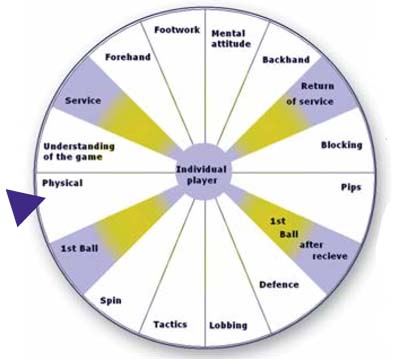
The higher level a player competes at, the more important his or her physical training becomes. And while it is important to introduce physical training to younger players it should be done carefully and in a playful way so as not to scare them away. In the long run, as the young player looks to improve, physical training will naturally become a part of their training regime.
Physical training can be divided into four different categories:
*Endurance
*Strength
*Speed
*Flexibility
Endurance
Stamina is critical to maintaining a high level of play. When we tire, our concentration drops, we lose our footwork and our level of play drops. Good endurance will help us avoid those pitfalls.
Endurance training can be split into three areas, distance running, long interval running, and short interval running.
Distance running should be at least 30 minutes long. The pace should be kept at 60-70% of your personal maximum heart rate capacity. WE DON'T HAVE TO RUN TOO FAST.
Long interval training lasts approximately 3-5 minutes. It should include between 4-6 sets at 70% of your maximum heart rate. Always make sure you check your pulse to see that your heart rate is right. Start this training after you have reached a pulse rate of approximately 120/min. Between the intervals the pulse should go down to 120/min before you start the next set.
Short interval training is very good for table tennis players since it closely simulates the actual game play of our sport. Start by running for 70 seconds and then resting for 15 seconds. Do this exercise in sets of 6-8. An alternate training routine is running 15 seconds and then resting for 15 seconds 16 times. Do this exercise in sets of 3-5. At the start of both these exercises your pulse rate should be at 120/min. Resting time between sets should be long enough that the pulse drops back down to 120/min (approximately 1-2 minutes).
Strength/Speed
Strength and speed training are connected. We need both in order to be quick and to avoid injury as well as to improve our general athletic ability. The areas of the body that are the most important for table tennis are the legs, the body core and shoulders.
Higher-level players should use weights to build strength. However, it is important to remember that weight training can be harmful if the exercises are not completed properly so please consult with a physical trainer before beginning any weight program.
When working on strength you want to avoid building too much muscular volume or bulk. Keep in mind that the purpose of building strength is to improve movement at the table. The goal is to become faster and smoother at covering the entire table, in-and-out on short balls at the net, sideways out from the center of the table, and to the backhand. If you analyze your game honestly you can identify and work on the areas that need improvement.
Speed training should always be performed at maximum pace. If we do sprints at 20-30 yards, the resting time should be 10 times the sprinting time. To condition our legs, we can do various jumping and shadow drills.
The body core is also very important. We use our hips for rotating when we play. Try to have a good balance when working on the stomach and back areas. We should work a lot on the backside of the shoulder because we pull those muscles forward very quickly when playing the forehand strike.
Flexibility
Warming up before playing and stretching afterwards is a must. You shouldn't get injured if you understand and practice this philosophy. A soft muscle is a lot quicker than a stiff and that is one reason why your flexibility is important.
Try to make physical training a part of your practice and you will be rewarded. Good luck!
-Stellan
Look for many more tips and opportunities to learn from Stellan from the Paddle Palace catalog and at the Paddle Palace web site.
You can email Stellan at stellangie@hotmail.com
|