
Ping Pong Diplomacy 1971
[caption id="attachment_245" align="alignright" width="278"]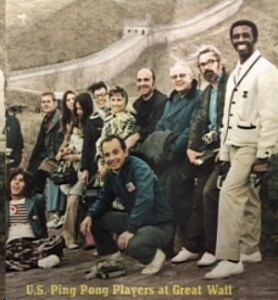 TIME Magazine Cover: US Table Tennis Team on Great Wall. April, 1971[/caption]
Nothing had prepared the world for the startling spectacle that happened in Peking, China in April of 1971. Chinese Premier, Chou En-lai greeted the first American delegation to set foot in the ancient Chinese capital since Mao Tse-tung took control of the land 22 years earlier. After nearly two decades of hostility towards the United States, fifteen American table tennis players and three journalists had made a breakthrough of historic proportions. One young American diplomat had clearly stated that he had joined the State Department to solve the problems of the world, and then sat analyzing the political impact of a ping pong game. Never before in history, has a sport been used so effectively as a tool for international diplomacy.
Even though China’s invitation to America came as a complete shock, it gave the communist nation a good opportunity to take a major step under the disguise of a sporting event that required no direct contact with Washington. It also gave China the opportunity to retreat if the intended results had failed. China’s ping pong ploy did offer the Nixon administration a bright future of opportunities. Immediately, it promised an easing of tensions in Asia and a prospect of profitable trade relations between the two countries. This move opened the door with dealings with the Soviet Union on crucial matters such as arms control in the Middle East. Only hours after Premier Chou’s welcome of the table tennis players, President Nixon announced initiatives to trade and travel between the U.S. and the People’s Republic of China.
The U.S. table tennis team was comprised from the world’s most improbable political diplomats ever. The group was lead by Graham Steenhoven, 59, a Chrysler Corp. personnel supervisor and President of the U.S. Table Tennis Association; Rufford Harrison, 40, a DuPont chemist; Tim Boggan, a University professor from New York; Jack Howard, 36, an IBM programmer from California; George Buben and his wife from Detroit; Glenn Cowan, 19, a student from Santa Monica, California; John Tannehill, 19, psychology major at Cincinnati University; Errol Resek, 29, an immigrant from the Dominican Republic and his wife Jairie; George Braithwaite, 36, a United Nations employee; Connie Sweeris, 20, a housewife from Grand Rapids, Mich.; Olga Soltesz, 17, of Orlando Florida; Judy Bochenski, 15, of Eugene, Oregon; and Dick Miles from Sports’s Illustrated and 10 times U.S. table tennis champion.
[caption id="attachment_243" align="alignright" width="200"]
TIME Magazine Cover: US Table Tennis Team on Great Wall. April, 1971[/caption]
Nothing had prepared the world for the startling spectacle that happened in Peking, China in April of 1971. Chinese Premier, Chou En-lai greeted the first American delegation to set foot in the ancient Chinese capital since Mao Tse-tung took control of the land 22 years earlier. After nearly two decades of hostility towards the United States, fifteen American table tennis players and three journalists had made a breakthrough of historic proportions. One young American diplomat had clearly stated that he had joined the State Department to solve the problems of the world, and then sat analyzing the political impact of a ping pong game. Never before in history, has a sport been used so effectively as a tool for international diplomacy.
Even though China’s invitation to America came as a complete shock, it gave the communist nation a good opportunity to take a major step under the disguise of a sporting event that required no direct contact with Washington. It also gave China the opportunity to retreat if the intended results had failed. China’s ping pong ploy did offer the Nixon administration a bright future of opportunities. Immediately, it promised an easing of tensions in Asia and a prospect of profitable trade relations between the two countries. This move opened the door with dealings with the Soviet Union on crucial matters such as arms control in the Middle East. Only hours after Premier Chou’s welcome of the table tennis players, President Nixon announced initiatives to trade and travel between the U.S. and the People’s Republic of China.
The U.S. table tennis team was comprised from the world’s most improbable political diplomats ever. The group was lead by Graham Steenhoven, 59, a Chrysler Corp. personnel supervisor and President of the U.S. Table Tennis Association; Rufford Harrison, 40, a DuPont chemist; Tim Boggan, a University professor from New York; Jack Howard, 36, an IBM programmer from California; George Buben and his wife from Detroit; Glenn Cowan, 19, a student from Santa Monica, California; John Tannehill, 19, psychology major at Cincinnati University; Errol Resek, 29, an immigrant from the Dominican Republic and his wife Jairie; George Braithwaite, 36, a United Nations employee; Connie Sweeris, 20, a housewife from Grand Rapids, Mich.; Olga Soltesz, 17, of Orlando Florida; Judy Bochenski, 15, of Eugene, Oregon; and Dick Miles from Sports’s Illustrated and 10 times U.S. table tennis champion.
[caption id="attachment_243" align="alignright" width="200"]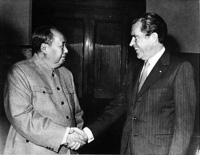 Mao and Nixon in 1972[/caption]
The American table tennis players, lead by team captain Jack Howard, did engage in friendly competition with their Chinese opponents at Tsinghua University. Fifty Chinese men, women and children, dressed in red jumpsuits "danced" out the tables and barriers for the matches, in full Chinese style. During the games themselves, 18,000 people watched from Peking’s magnificent Indoor Stadium, all clapping as one, all silent as one. The Chinese were amazed and amused by the long hair, bright colored clothes and red headband of American table tennis player, Glenn Cowan. He was clearly the favorite of the crowd. The Chinese won the Men’s games 5-3 and the Women’s 5-4. Afterwards, the two teams exchanged gifts and walked off together hand-in-hand. One thing was all too clear to the Americans … the Chinese were trying hard NOT to embarrass the Americans by lop-sided scores.
The U.S. team paid a historical visit to the Great Wall of China, an Ancient Summer Palace outside Peking and strolled through the streets of Shanghai. They were treated like royalty from the moment they stepped foot in China, with 8-course meals and a choice of seats wherever they went. Tours of the majestic mountains and open fields of bamboo shoots were given with pleasure. The people of China were kind, but they seemed to have no emotions or personalities and dressed in dull military-like uniforms. Pictures of Mao Tse-tung were everywhere and loudspeakers played propaganda messages continuously. The Chinese made it very clear that they welcomed the "People of America" with tremendous interest and curiosity.
[caption id="attachment_244" align="alignleft" width="298"]
Mao and Nixon in 1972[/caption]
The American table tennis players, lead by team captain Jack Howard, did engage in friendly competition with their Chinese opponents at Tsinghua University. Fifty Chinese men, women and children, dressed in red jumpsuits "danced" out the tables and barriers for the matches, in full Chinese style. During the games themselves, 18,000 people watched from Peking’s magnificent Indoor Stadium, all clapping as one, all silent as one. The Chinese were amazed and amused by the long hair, bright colored clothes and red headband of American table tennis player, Glenn Cowan. He was clearly the favorite of the crowd. The Chinese won the Men’s games 5-3 and the Women’s 5-4. Afterwards, the two teams exchanged gifts and walked off together hand-in-hand. One thing was all too clear to the Americans … the Chinese were trying hard NOT to embarrass the Americans by lop-sided scores.
The U.S. team paid a historical visit to the Great Wall of China, an Ancient Summer Palace outside Peking and strolled through the streets of Shanghai. They were treated like royalty from the moment they stepped foot in China, with 8-course meals and a choice of seats wherever they went. Tours of the majestic mountains and open fields of bamboo shoots were given with pleasure. The people of China were kind, but they seemed to have no emotions or personalities and dressed in dull military-like uniforms. Pictures of Mao Tse-tung were everywhere and loudspeakers played propaganda messages continuously. The Chinese made it very clear that they welcomed the "People of America" with tremendous interest and curiosity.
[caption id="attachment_244" align="alignleft" width="298"]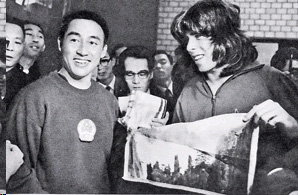 A gift from Zhuang to US Table Tennis player Glenn Cowan helped lead to a U.S.-China exhibition in Beijing and the end of 22 years of Chinese isolation from the West.[/caption]
China did allow the American journalists, who accompanied the table tennis team, to shoot more than 10,000 feet of colored film during the visit. Voice-casts were made to the U.S. by telephone relays and there was no evidence of censorship. China had waived it’s rule requiring all film to be developed and inspected. The most important message the Americans brought back with them was what their hosts got across in a subtle way: That China is a united, rational society trying to open the doors to other parts of the world.
[caption id="attachment_248" align="aligncenter" width="500"]
A gift from Zhuang to US Table Tennis player Glenn Cowan helped lead to a U.S.-China exhibition in Beijing and the end of 22 years of Chinese isolation from the West.[/caption]
China did allow the American journalists, who accompanied the table tennis team, to shoot more than 10,000 feet of colored film during the visit. Voice-casts were made to the U.S. by telephone relays and there was no evidence of censorship. China had waived it’s rule requiring all film to be developed and inspected. The most important message the Americans brought back with them was what their hosts got across in a subtle way: That China is a united, rational society trying to open the doors to other parts of the world.
[caption id="attachment_248" align="aligncenter" width="500"]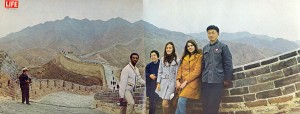 In LIFE Magazine: George Braithwaite, Olga Soltesz, and Judy Bochenski (Hoarfrost) at the Great Wall in 1971[/caption]
This article is reprinted from United States Table Tennis Federation Website: www.usttf.org
In LIFE Magazine: George Braithwaite, Olga Soltesz, and Judy Bochenski (Hoarfrost) at the Great Wall in 1971[/caption]
This article is reprinted from United States Table Tennis Federation Website: www.usttf.org
 TIME Magazine Cover: US Table Tennis Team on Great Wall. April, 1971[/caption]
Nothing had prepared the world for the startling spectacle that happened in Peking, China in April of 1971. Chinese Premier, Chou En-lai greeted the first American delegation to set foot in the ancient Chinese capital since Mao Tse-tung took control of the land 22 years earlier. After nearly two decades of hostility towards the United States, fifteen American table tennis players and three journalists had made a breakthrough of historic proportions. One young American diplomat had clearly stated that he had joined the State Department to solve the problems of the world, and then sat analyzing the political impact of a ping pong game. Never before in history, has a sport been used so effectively as a tool for international diplomacy.
Even though China’s invitation to America came as a complete shock, it gave the communist nation a good opportunity to take a major step under the disguise of a sporting event that required no direct contact with Washington. It also gave China the opportunity to retreat if the intended results had failed. China’s ping pong ploy did offer the Nixon administration a bright future of opportunities. Immediately, it promised an easing of tensions in Asia and a prospect of profitable trade relations between the two countries. This move opened the door with dealings with the Soviet Union on crucial matters such as arms control in the Middle East. Only hours after Premier Chou’s welcome of the table tennis players, President Nixon announced initiatives to trade and travel between the U.S. and the People’s Republic of China.
The U.S. table tennis team was comprised from the world’s most improbable political diplomats ever. The group was lead by Graham Steenhoven, 59, a Chrysler Corp. personnel supervisor and President of the U.S. Table Tennis Association; Rufford Harrison, 40, a DuPont chemist; Tim Boggan, a University professor from New York; Jack Howard, 36, an IBM programmer from California; George Buben and his wife from Detroit; Glenn Cowan, 19, a student from Santa Monica, California; John Tannehill, 19, psychology major at Cincinnati University; Errol Resek, 29, an immigrant from the Dominican Republic and his wife Jairie; George Braithwaite, 36, a United Nations employee; Connie Sweeris, 20, a housewife from Grand Rapids, Mich.; Olga Soltesz, 17, of Orlando Florida; Judy Bochenski, 15, of Eugene, Oregon; and Dick Miles from Sports’s Illustrated and 10 times U.S. table tennis champion.
[caption id="attachment_243" align="alignright" width="200"] Mao and Nixon in 1972[/caption]
The American table tennis players, lead by team captain Jack Howard, did engage in friendly competition with their Chinese opponents at Tsinghua University. Fifty Chinese men, women and children, dressed in red jumpsuits "danced" out the tables and barriers for the matches, in full Chinese style. During the games themselves, 18,000 people watched from Peking’s magnificent Indoor Stadium, all clapping as one, all silent as one. The Chinese were amazed and amused by the long hair, bright colored clothes and red headband of American table tennis player, Glenn Cowan. He was clearly the favorite of the crowd. The Chinese won the Men’s games 5-3 and the Women’s 5-4. Afterwards, the two teams exchanged gifts and walked off together hand-in-hand. One thing was all too clear to the Americans … the Chinese were trying hard NOT to embarrass the Americans by lop-sided scores.
The U.S. team paid a historical visit to the Great Wall of China, an Ancient Summer Palace outside Peking and strolled through the streets of Shanghai. They were treated like royalty from the moment they stepped foot in China, with 8-course meals and a choice of seats wherever they went. Tours of the majestic mountains and open fields of bamboo shoots were given with pleasure. The people of China were kind, but they seemed to have no emotions or personalities and dressed in dull military-like uniforms. Pictures of Mao Tse-tung were everywhere and loudspeakers played propaganda messages continuously. The Chinese made it very clear that they welcomed the "People of America" with tremendous interest and curiosity.
[caption id="attachment_244" align="alignleft" width="298"] A gift from Zhuang to US Table Tennis player Glenn Cowan helped lead to a U.S.-China exhibition in Beijing and the end of 22 years of Chinese isolation from the West.[/caption]
China did allow the American journalists, who accompanied the table tennis team, to shoot more than 10,000 feet of colored film during the visit. Voice-casts were made to the U.S. by telephone relays and there was no evidence of censorship. China had waived it’s rule requiring all film to be developed and inspected. The most important message the Americans brought back with them was what their hosts got across in a subtle way: That China is a united, rational society trying to open the doors to other parts of the world.
[caption id="attachment_248" align="aligncenter" width="500"]
TIME Magazine Cover: US Table Tennis Team on Great Wall. April, 1971[/caption]
Nothing had prepared the world for the startling spectacle that happened in Peking, China in April of 1971. Chinese Premier, Chou En-lai greeted the first American delegation to set foot in the ancient Chinese capital since Mao Tse-tung took control of the land 22 years earlier. After nearly two decades of hostility towards the United States, fifteen American table tennis players and three journalists had made a breakthrough of historic proportions. One young American diplomat had clearly stated that he had joined the State Department to solve the problems of the world, and then sat analyzing the political impact of a ping pong game. Never before in history, has a sport been used so effectively as a tool for international diplomacy.
Even though China’s invitation to America came as a complete shock, it gave the communist nation a good opportunity to take a major step under the disguise of a sporting event that required no direct contact with Washington. It also gave China the opportunity to retreat if the intended results had failed. China’s ping pong ploy did offer the Nixon administration a bright future of opportunities. Immediately, it promised an easing of tensions in Asia and a prospect of profitable trade relations between the two countries. This move opened the door with dealings with the Soviet Union on crucial matters such as arms control in the Middle East. Only hours after Premier Chou’s welcome of the table tennis players, President Nixon announced initiatives to trade and travel between the U.S. and the People’s Republic of China.
The U.S. table tennis team was comprised from the world’s most improbable political diplomats ever. The group was lead by Graham Steenhoven, 59, a Chrysler Corp. personnel supervisor and President of the U.S. Table Tennis Association; Rufford Harrison, 40, a DuPont chemist; Tim Boggan, a University professor from New York; Jack Howard, 36, an IBM programmer from California; George Buben and his wife from Detroit; Glenn Cowan, 19, a student from Santa Monica, California; John Tannehill, 19, psychology major at Cincinnati University; Errol Resek, 29, an immigrant from the Dominican Republic and his wife Jairie; George Braithwaite, 36, a United Nations employee; Connie Sweeris, 20, a housewife from Grand Rapids, Mich.; Olga Soltesz, 17, of Orlando Florida; Judy Bochenski, 15, of Eugene, Oregon; and Dick Miles from Sports’s Illustrated and 10 times U.S. table tennis champion.
[caption id="attachment_243" align="alignright" width="200"] Mao and Nixon in 1972[/caption]
The American table tennis players, lead by team captain Jack Howard, did engage in friendly competition with their Chinese opponents at Tsinghua University. Fifty Chinese men, women and children, dressed in red jumpsuits "danced" out the tables and barriers for the matches, in full Chinese style. During the games themselves, 18,000 people watched from Peking’s magnificent Indoor Stadium, all clapping as one, all silent as one. The Chinese were amazed and amused by the long hair, bright colored clothes and red headband of American table tennis player, Glenn Cowan. He was clearly the favorite of the crowd. The Chinese won the Men’s games 5-3 and the Women’s 5-4. Afterwards, the two teams exchanged gifts and walked off together hand-in-hand. One thing was all too clear to the Americans … the Chinese were trying hard NOT to embarrass the Americans by lop-sided scores.
The U.S. team paid a historical visit to the Great Wall of China, an Ancient Summer Palace outside Peking and strolled through the streets of Shanghai. They were treated like royalty from the moment they stepped foot in China, with 8-course meals and a choice of seats wherever they went. Tours of the majestic mountains and open fields of bamboo shoots were given with pleasure. The people of China were kind, but they seemed to have no emotions or personalities and dressed in dull military-like uniforms. Pictures of Mao Tse-tung were everywhere and loudspeakers played propaganda messages continuously. The Chinese made it very clear that they welcomed the "People of America" with tremendous interest and curiosity.
[caption id="attachment_244" align="alignleft" width="298"] A gift from Zhuang to US Table Tennis player Glenn Cowan helped lead to a U.S.-China exhibition in Beijing and the end of 22 years of Chinese isolation from the West.[/caption]
China did allow the American journalists, who accompanied the table tennis team, to shoot more than 10,000 feet of colored film during the visit. Voice-casts were made to the U.S. by telephone relays and there was no evidence of censorship. China had waived it’s rule requiring all film to be developed and inspected. The most important message the Americans brought back with them was what their hosts got across in a subtle way: That China is a united, rational society trying to open the doors to other parts of the world.
[caption id="attachment_248" align="aligncenter" width="500"]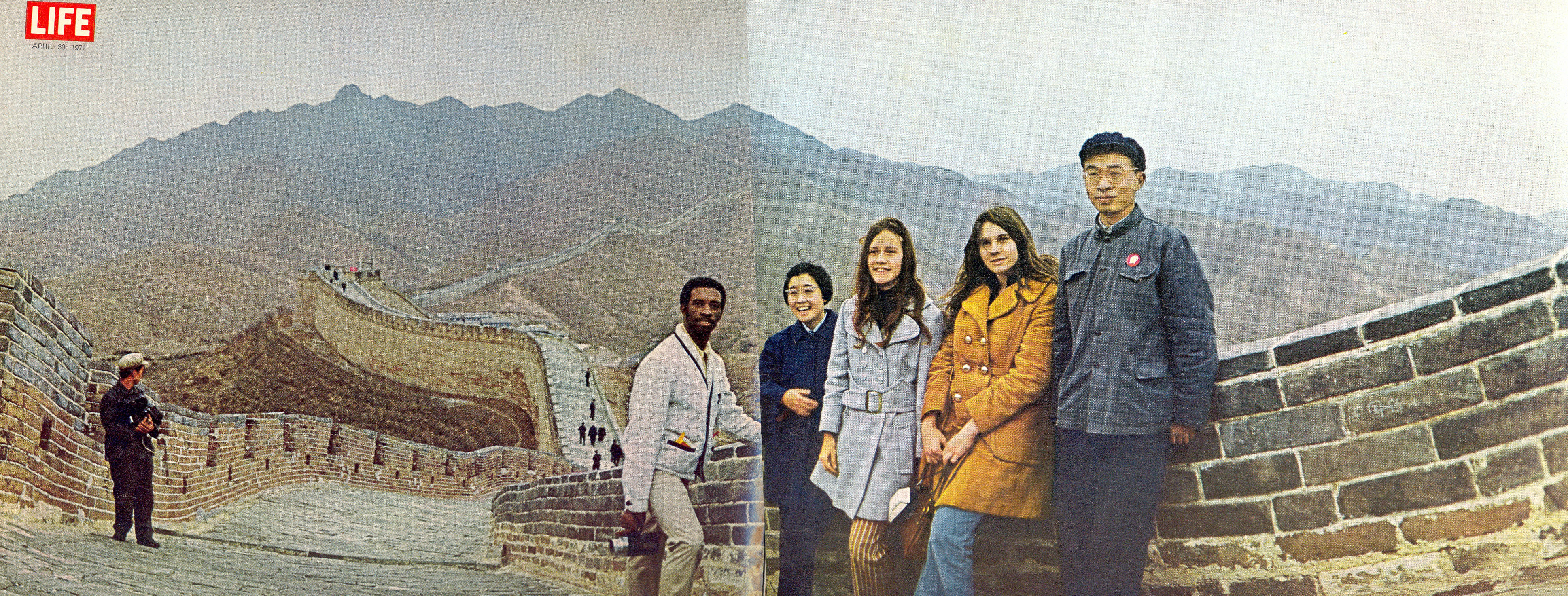 In LIFE Magazine: George Braithwaite, Olga Soltesz, and Judy Bochenski (Hoarfrost) at the Great Wall in 1971[/caption]
This article is reprinted from United States Table Tennis Federation Website: www.usttf.org
In LIFE Magazine: George Braithwaite, Olga Soltesz, and Judy Bochenski (Hoarfrost) at the Great Wall in 1971[/caption]
This article is reprinted from United States Table Tennis Federation Website: www.usttf.org
Previous post
If You Like to Attack from Both Sides Try This.
Next post
Obama and British PM played ping pong in London
Related Posts

Paddle Palace Club 2026 Fall Open: Two Days of Competition in Tigard
The Paddle Palace Club welcomed players to Tigard, Oregon, for the 2026 Fall Open on September 26-27. The two-day USATT 1-Star tournament featured competition...
Sep 30 2026

Abigail Yu Brings Home Four Medals from the ITTF-Americas Youth Championships
Paddle Palace athlete Abigail Yu put together an outstanding week for Team USA at the 2026 ITTF-Americas Youth Championships in Guatemala City, earning two gold...
Sep 20 2026

Paddle Palace Young Stars Shine at 2026 ITTF Americas U11 & U13 Championships
The future of American table tennis was on full display in Texas, and two young Paddle Palace players came home with an impressive collection...
Sep 19 2026

How to Put Away High Balls in Table Tennis | 3 Tips from Seth Pech
A high ball looks like an easy winner. Then you swing, catch it wrong, and watch it sail off the end of the table....
Sep 19 2026

Remembering Bill Rasmussen: How ESPN Gave American Table Tennis a National Stage
Bill Rasmussen, whose idea for a 24-hour sports network led to the launch of ESPN in 1979, died on August 18, 2026, at age...
Aug 20 2026

Mikael Appelgren: The Swedish Master of Feel, Variation and Control
There are players whose results tell you how good they were. Then there are players you need to watch. Mikael Appelgren belongs in both...
Aug 18 2026

From Promise to Champion: Paddle Palace’s Mia Yang Captures U.S. National Title
Every once in a while, you witness a performance that reminds you why investing in young athletes matters. We are incredibly proud to congratulate...
Aug 12 2026

Paddle Palace Retains the Club vs. Club Trophy
A day of great matches, big smiles, and one unforgettable comeback. There are plenty of ways to measure the success of a table tennis...
Aug 04 2026


